Is education AI’s real killer app?
How many great teachers have you ever had?
I’m thinking of the rare individuals who not only expand your understanding of the world, but also inspire you. Most of us are lucky to have had one or two such teachers in our entire educational career.
A tiny minority of teachers seems to be universally appreciated, blessed with a gift for connecting with virtually any student. But more often, a teacher who’s a good fit for some students might not be for others.
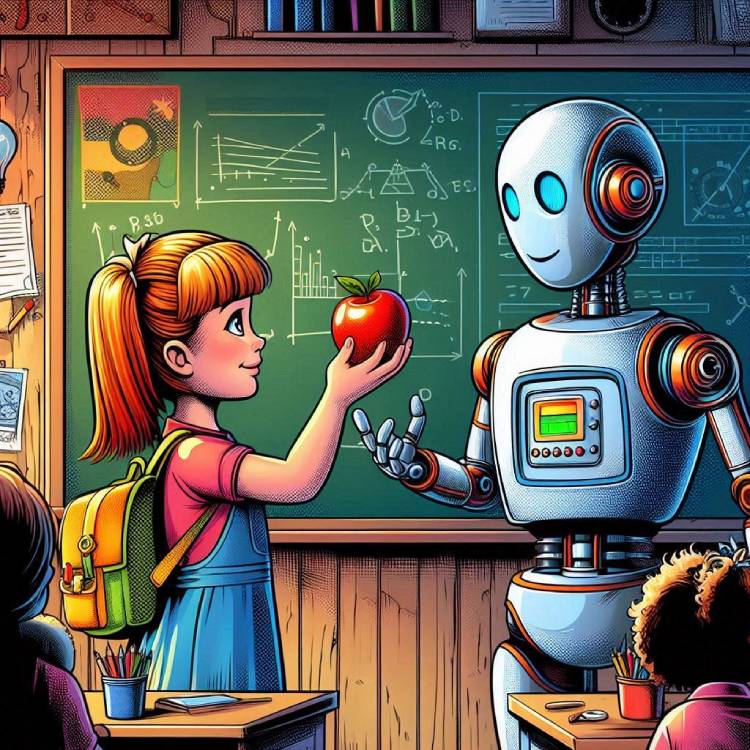
AI is going to change this. Instead of leaving it to chance, AI will provide a great teacher for every student — and not just for one class or one year, but for a lifetime of learning.
If you’re familiar with the history of technology in education, you might be skeptical of such a bold claim. Successive waves of PCs and laptops in classrooms over the last 40 years have had a much smaller impact than their proponents promised.
This time will be different because AI as a technology is different.
The increasingly human-like characteristics of AI will make it possible to build rapport, identify interests, recognize learning styles, and personalize instruction. And unlike even the greatest human teacher, an AI teacher will never have a bad day. AI will deliver great teaching to every student every day, with unlimited patience.
In other fields, we can already see the potential of these new AI capabilities.
For example, in healthcare, AI is being used to check in on patients who are living with chronic diseases. In periodic phone conversations, the AI gets to know the patient as a whole person who’s more than just a collection of medical issues, and is able to make small talk about what’s been happening in the patient’s life.
Similarly, in education, AI will develop an enduring personal connection with each student. It might begin in preschool and last a lifetime.
In this way, the AI teacher will become an expert on you.
Whether you’re interested in dinosaurs at age four, baseball at ten, or poetry at 16, AI will flexibly adapt the lesson to the learner.
Unlike the Roman army organization of traditional classroom instruction — with students marching together in lockstep — AI teaching will take into account how each student actually learns most effectively.
A teaching method that engages some students may bore others — or leave them behind. Human teachers have long known this, of course, but few have the time or resources to personalize their teaching style for every student.
Most teachers, too, have only a relatively brief window of a semester or a year in which to make a difference. After that, the student moves on to a new teacher, who essentially starts from scratch.
In contrast, the AI teacher will have an uninterrupted, long-term connection with each student. So the degree of personalization will increase over time, rather than periodically reset to zero.
AI-powered instruction has the potential to deliver all of these educational benefits to people everywhere. That would be a huge change from the status quo, in which a student’s ZIP code has a significant role in determining educational outcomes.
To be sure, AI technology alone won’t be able to address a variety of socioeconomic factors that contribute to success in the educational system. But AI will diminish disparities to a significant degree, delivering a better education to far more people, wherever they live.
Will AI entirely replace human teachers? No, but their role is likely to evolve, with an increasing focus on guiding and mentoring students.
And social aspects of education — what students learn by interacting with one another — are certain to remain a central part of the school experience.
As interest in AI has exploded over the last two years, the list of fields that it seems poised to transform has grown ever longer. But education may turn out to be AI’s real killer app. The largest benefit of tomorrow’s thinking machines may come from teaching people how to think.■